
Drowning is the single largest injury risk facing children with autism. Research published in the American Journal of Public Health found that children with autism are roughly 160 times as likely to die from drowning as the general pediatric population.
That number is frightening, and it should be, but it is also actionable. The risk comes from a specific and well-understood combination: a tendency to leave safe spaces without warning, a strong pull toward water, and limited awareness of danger. Each part of that chain can be addressed.
This guide covers what the research actually establishes, what it does not, and the measures that make the biggest difference. If elopement is already a concern in your family, it is one of the things ABA parent training works on directly.
What the Research Establishes
Three findings matter most, and it is worth being precise about each.
Roughly half of children with autism attempt to elope. Anderson and colleagues, publishing in Pediatrics, surveyed families of 1,218 children with autism. Forty-nine percent had attempted to wander at least once since the age of four. Among their siblings without autism, the figure was 13%.
Drowning is the dominant injury risk. Guan and Li analysed US mortality data from 1999 to 2014 and identified 1,367 deaths of people with an autism diagnosis. Twenty-eight percent died from injury, and among children with autism, suffocation, asphyxiation and drowning together accounted for nearly 80% of injury deaths. People with autism were about three times as likely as the general population to die from injury.
The 160 figure applies to children. Columbia University’s Mailman School, reporting on that study, states that children with autism are 160 times as likely to die from drowning as the general pediatric population. It is a mortality comparison for children, not a measure of how often children with autism have accidents in water, and it does not describe adults.
For baseline context, the CDC reports that drowning causes more deaths than any other cause among children aged one to four, and is the second leading cause of unintentional injury death for ages five to fourteen. There are roughly 4,000 fatal unintentional drownings in the US each year.
Where Incidents Happen, and What That Evidence Is Worth
You will see confident claims online that most autism drownings happen in ponds, within about 300 metres of home, in the afternoon. Those claims trace to one study, and it deserves to be described accurately.
Researchers searched US newspaper archives from January 2000 to May 2017 and found 23 reported fatal drownings of children with autism under fifteen. Among those 23 cases, ponds accounted for 52.2%, rivers for 13% and lakes for 13%. Of the 11 cases where location data was available, the water body averaged 291 metres from the child’s home. Of the 15 cases with timing data, 11 occurred in the afternoon.
The authors are candid about the limits. The sample is small. It depends entirely on what newspapers chose to report, and they describe it as capturing only the tip of the iceberg. Percentages drawn from 11 or 15 cases should not be treated as population rates.
What the study does support, directionally, is worth acting on. Open natural water close to home appears in these cases far more often than backyard pools, and unstructured afternoon hours come up repeatedly. For North Carolina families, that pattern lands squarely: retention ponds in subdivisions, farm ponds, creeks, and rivers are ordinary features of the landscape here, and they have no fences, no lifeguards, and no barriers.
Securing the Home First
Most elopement starts with a door. Layering is what works, because any single measure eventually fails.
Fit door and window alarms, including on sliding doors. Inexpensive battery chime alarms are enough, and the point is that nobody can leave silently.
Add secondary locks high on exterior doors, above a child’s reach. Keep the keys where adults can find them quickly in a fire.
If you have a pool, fence it on all four sides with a self-closing, self-latching gate, so the house itself is not one wall of the enclosure. Pool alarms are a useful addition and a poor substitute.
Walk your own neighbourhood and find the water. Retention ponds, drainage ditches, creeks and neighbours’ pools within a few hundred metres are the places to know about before you ever need to search. Families we work with often find water they had never noticed.
Teaching Water Skills
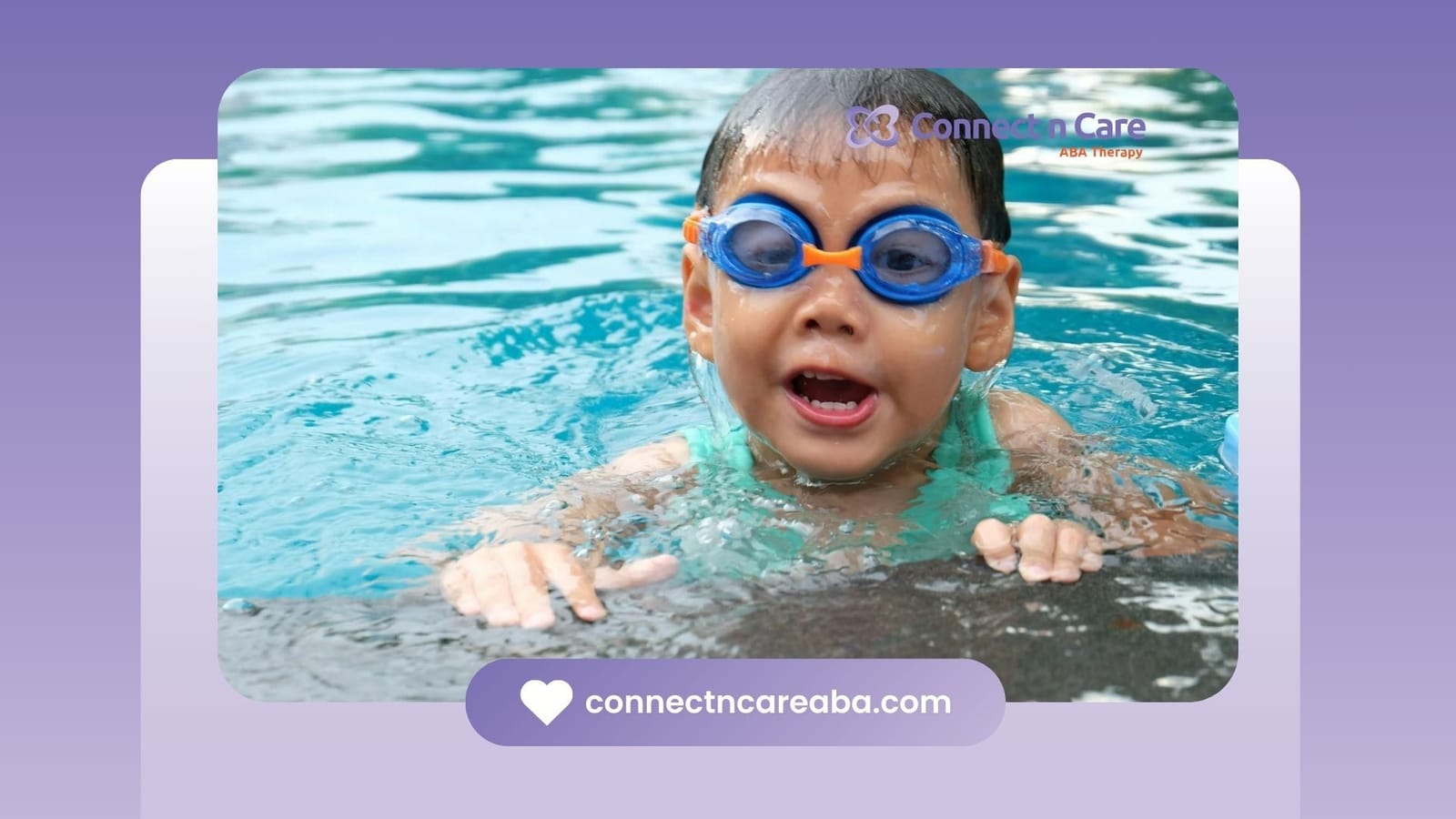
Swim lessons are prevention, not recreation. The researcher behind the mortality study recommends that children begin swim classes as soon as possible after an autism diagnosis.
Adapted lessons matter more than lesson count. An instructor experienced with autistic learners will use visual supports, predictable routines, and gradual desensitisation rather than expecting a child to follow spoken group instruction. Many YMCAs and community pools in North Carolina run adaptive or one-to-one programmes, and it is worth asking specifically whether instructors have worked with autistic children before booking.
Teach survival skills before strokes. Rolling onto the back, floating, breathing and reaching an edge are what save a child who has fallen in unexpectedly. Technique can come later.
Practise in clothing at least once. A child who falls into a pond is not wearing swimwear, and clothed swimming feels completely different.
One caution worth keeping in view: swim ability reduces risk but does not remove it, and a child who swims well may be more inclined to enter water alone. Lessons supplement supervision rather than replacing it.
Preparing for the Worst Day
If your child does go missing, the first minutes decide the outcome.
Search water first. Standard missing-child instinct is to search the house, then the street. For a child who is drawn to water, the nearest pond or creek should be checked immediately by someone, while another person calls 911.
Tell the dispatcher two things straight away: that your child is autistic, and that they are drawn to water. That changes how the response is prioritised and where responders look.
Several North Carolina sheriff’s offices operate Project Lifesaver, which provides a wristband transmitter for people who wander, including autistic individuals, with a trained search team and locator equipment. Catawba County reports an average recovery time of around 30 minutes. Programmes are county-run, so availability varies, and your county sheriff’s office can tell you whether one operates locally and how to enrol.
Before any of that is needed, give neighbours a current photo and your phone number, and tell them plainly that your child may head for water. People help readily when they know what to watch for.
Building Safety Into Therapy
Elopement is a behaviour, which means it can be assessed and addressed rather than only contained.
A behaviour analyst can work out what elopement achieves for your child. Escaping noise, reaching for something enjoyable, and seeking sensory input all look identical from the outside and call for different responses. Teaching a child to request a break, or to ask to go outside, removes the reason for leaving unannounced.
Safety skills can be taught the same way as any other: staying with an adult, stopping on command, asking before entering water. These are slow-building skills, taught in small steps and practised in real settings.
In-home ABA therapy is particularly suited to this, because the work happens in the house and neighbourhood where elopement actually occurs rather than in a clinic room. Our teams work with families throughout North Carolina.
Structured activity also reduces opportunity. The afternoon pattern in the drowning research overlaps with unstructured time, and our guides to summer activities for autistic children cover practical ways to fill it. For seasonal outings near water, our North Carolina July 4th guide includes water-safety planning.
Conclusion
Drowning prevention for children with autism requires more than teaching them how to swim. Research shows that elopement, attraction to water, and limited awareness of danger can increase the risk of drowning. However, families can take practical steps to reduce these risks through home safety measures, adapted swim lessons, active supervision, and emergency planning.
For families in North Carolina, prevention starts with identifying nearby water hazards, securing doors and pools, and teaching children essential safety skills. Addressing elopement through behavioral interventions can also help children learn to stay close to caregivers, respond to safety instructions, and communicate their needs more effectively.
Where to Start
The drowning risk facing autistic children is real and large, and the measures that reduce it are mostly ordinary: alarms on doors, a fence around the pool, knowing where the water is near your home, swim lessons with the right instructor, and a plan everyone knows for the day something goes wrong. None of it requires certainty about which statistic is most precise. If you do only one thing this week, walk your neighbourhood and find every body of water within a few hundred metres of your front door.
Connect n Care ABA supports families across North Carolina through in-home ABA therapy, center-based ABA therapy and ABA parent training, including assessment and treatment of elopement and the safety skills that go with it.
To talk through what would help your family, contact our team.
SOURCES:
- https://www.publichealth.columbia.edu/news/individuals-autism-substantially-heightened-risk-injury-death
- https://pubmed.ncbi.nlm.nih.gov/28590851/
- https://www.iacc.hhs.gov/publications/summary-of-advances/2012/question5.shtml
- https://link.springer.com/article/10.1186/s40621-017-0129-4
- https://www.cdc.gov/drowning/data-research/facts/index.html
- https://catawbacountync.gov/county-services/sheriffs-office/programs/project-lifesaver/