
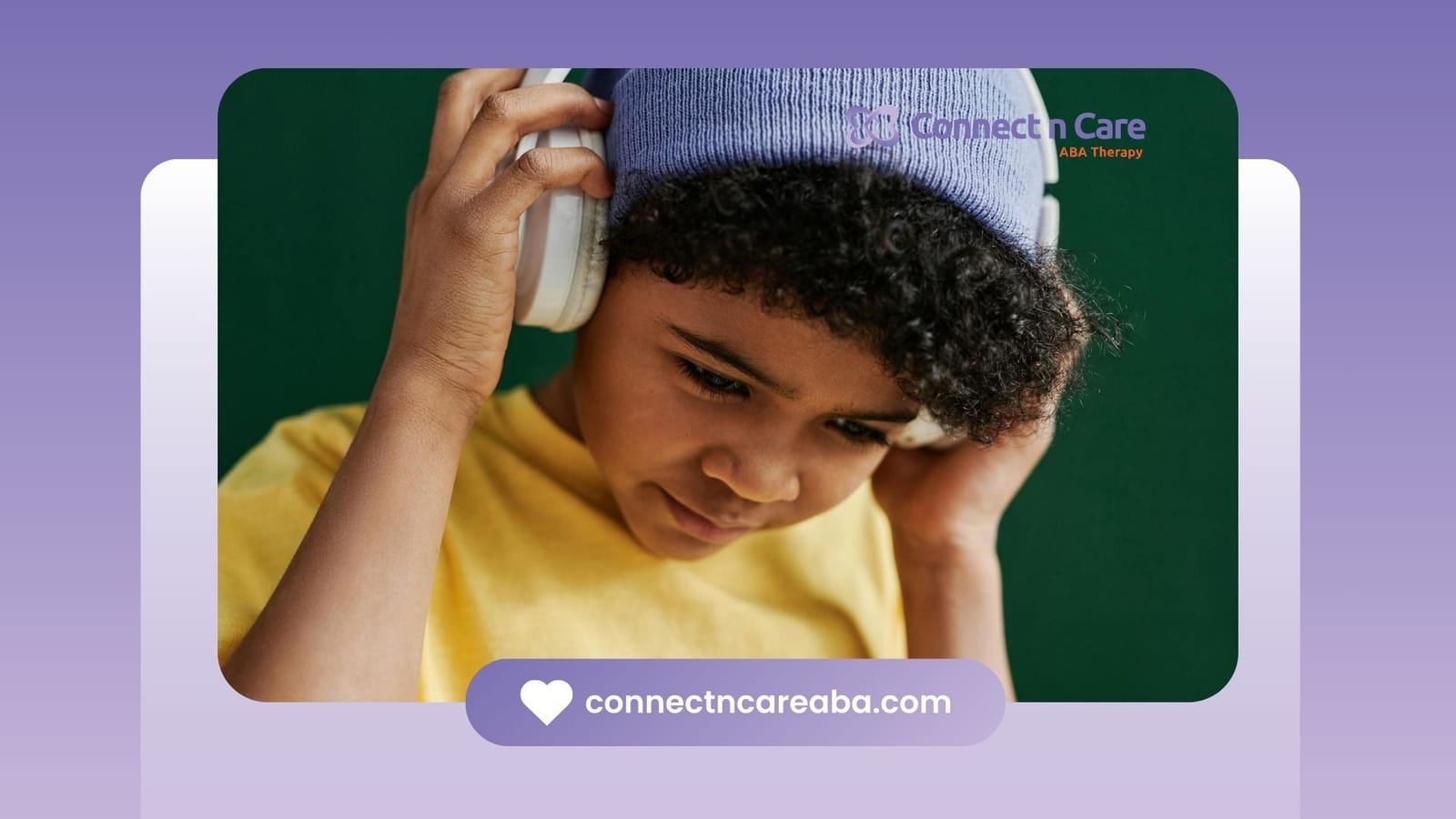
Noise-canceling headphones help a great many autistic people, but they are not a single solution, and the type matters more than the brand. Active noise cancellation and passive ear defenders block completely different kinds of sound, and the one most families buy is often not the one their child needs.
There is also a caution worth knowing before you make them part of everyday life. This guide covers what each type actually blocks, when they help, when constant use can work against your child, and how to choose.
If your child's sound sensitivity is affecting school or daily routines, our team works with families across North Carolina on exactly this kind of challenge.
Why Sound Is Harder for Many Autistic People
The CDC lists unusual reactions to the way things sound among the characteristics of autism spectrum disorder. For a lot of autistic people, that means the brain does not filter background sound the way it does for most people, so the hum of a fridge, a scraping chair, and a conversation across the room all arrive at similar volume.
The result is not simply dislike. Sustained unfiltered input is exhausting, and it uses up the capacity a person needs for listening, talking and regulating. By the time a child reaches the point of covering their ears, they have usually been coping for a while.
Covering the ears is itself a form of self-regulation. Our explainer on what stimming means in autism covers why these behaviors are worth understanding rather than stopping.
What Noise Cancellation Actually Blocks
This is where most buying decisions go wrong.
Active noise cancellation uses microphones to detect incoming sound and generates an opposite wave to cancel it. It is particularly effective on consistent low-frequency sound: airplane engines, train rumble, air conditioning, road noise. It is far less effective on sudden, sharp, high-frequency sound.
Passive isolation, which is what ear defenders and earmuffs provide, blocks sound physically with padding and a seal. It handles mid and high frequencies well, which is the range that most sharp sounds sit in.
Now consider what actually sets an autistic child off: a hand dryer starting, a fire alarm, a scream in a corridor, a chair scraping, cutlery on a plate. Those are sudden and high-frequency. Passive ear defenders do more for those than active cancellation does.
Active cancellation is the better choice for a long car journey, a flight or a humming classroom. Passive ear defenders are the better choice for a supermarket, a school corridor or a birthday party. Many families end up owning both, and that is a reasonable outcome rather than a failure to choose.
When Ear Defenders Help, and When They May Backfire
Ear defenders work. The complication is what happens when they are worn all day, every day.
NHS guidance used in autism services states that the continued use of ear defenders results in an increase in a child's auditory gain, which makes the child more sensitive to sound rather than less. The same guidance is firm that a child being formally treated for hyperacusis should not use ear defenders at all, because they impede recovery.
The underlying research is still developing. Reviews of auditory gain and sound therapy support the neural mechanism but note that controlled clinical trials are lacking, so this is a reasonable caution rather than a settled finding. It is enough to change how you use them.
The practical approach most clinicians land on is to treat ear defenders like a tool you reach for, not a uniform:
- During genuine sensory overload, or when a meltdown is building
- Before a known difficult event, such as an assembly, a fireworks display or a busy station
- When your child is unwell, since sensory processing is often heightened then
- Not as a default for ordinary environments your child can manage
Alongside that, the NHS guidance recommends building tolerance: explaining what is making a sound, giving the child some control over it, repeated gentle exposure, and always providing somewhere quiet to retreat to. If a child has no safe place to go, the headphones become the only option they have.
That tolerance-building work is a normal part of therapy. In center-based ABA therapy, a team can introduce a difficult sound in a controlled way, at a level your child can handle, and build from there. Families we work with often find this reduces how often the headphones are needed at all.
Choosing Between Ear Defenders and ANC Headphones
Specific models change every year, which is why product roundups age badly. The criteria do not.
For younger children, passive ear defenders usually win. Look for a Noise Reduction Rating printed on the packaging, a headband that adjusts small enough to seal properly on a child's head, and a build that survives being dropped and thrown. No battery means nothing to fail mid-outing. They cost a fraction of consumer ANC headphones.
For teenagers and adults, ANC over-ear headphones make more sense, especially if the person also wants music or audiobooks. Look for a transparency or ambient mode so they can hear someone speaking without taking them off, physical buttons rather than touch controls, which are easier to use without looking, and comfortable clamping pressure, since a tight fit becomes its own sensory problem.
For everyone, fit beats specification. A cheaper pair that is comfortable enough to wear will do more than an expensive pair that gets rejected in ten minutes. Where possible, let the person try them on before buying.
Headphones also sit alongside other regulation tools rather than replacing them. Our guide to fidget toys for autism covers options that work in situations where headphones are not practical.
Hearing Safety and Volume
If the headphones are used for listening and not only for blocking, volume matters.
The NIDCD puts sounds at or around 70 dBA as generally safe for extended periods, and notes that any sound at or above 85 dBA is more likely to damage hearing over time. Headphones at maximum volume commonly reach 94 to 110 dBA. At 100 dBA, damage can begin within about 14 minutes.
Two things follow. Use a volume limiter if the device offers one, and be aware that a child using music to mask an overwhelming environment will tend to push the volume up as the room gets louder. Noise cancellation actually helps here, because it reduces the background the person is competing with, so they listen at a lower level.
Introducing Headphones Without a Fight
A new object pressed onto the head of a child who is already overwhelmed will be rejected, and the rejection can be hard to undo.
Introduce them when things are calm, never mid-meltdown. Let your child hold them, look at them, and put them on themselves. Start with short wears in a quiet room, a minute or two, and build from there. Let your child take them off whenever they want, because the sense of control is most of what makes them acceptable.
Once they are tolerated at home, use them for one predictable outing before relying on them for a hard one. And if the person can tell you they do not want them, that answer counts. Our overview of autism overstimulation covers other ways to reduce load when headphones are not the right fit.
Headphones at School in North Carolina
If sound sensitivity is affecting your child's school day, this is something the school can be asked to address formally rather than informally.
Special education in North Carolina public schools is overseen by the Office of Exceptional Children at the NC Department of Public Instruction, which supports students with disabilities through an individualized education program in the least restrictive environment. Sensory supports, including permission to use ear defenders, access to a quiet space, and advance warning before fire drills, can be written into an IEP or a 504 plan.
Getting it in writing matters. An informal arrangement with one teacher disappears the following September. A documented accommodation follows your child.
Virginia families go through the same federal IDEA framework, administered through the Virginia Department of Education.
A school-based team can also help here. School-based ABA therapy puts a therapist in the setting where the difficulty is actually happening, which makes it far easier to work out which sounds are the problem and what helps.
Conclusion
Noise-canceling headphones can make everyday environments more comfortable for autistic children who experience sound sensitivity. Choosing between active noise cancellation and passive ear defenders depends on the types of sounds your child finds overwhelming. The right fit, comfort, and timing also matter. While headphones can provide relief during noisy situations, they work best as part of a broader approach that includes sensory accommodations, quiet spaces, and gradual support for managing everyday sounds.
Every child's sensory needs are different, and finding the right strategies can take time. With the right support at home, at school, and in the community, children can develop ways to manage overwhelming environments while feeling more comfortable and confident in their daily routines.
Making the Right Choice for Your Child
Noise-canceling headphones are a genuinely useful tool for autistic people, and the right type depends on what sounds cause the trouble. Passive ear defenders handle sudden sharp noise, active cancellation handles steady hum, and comfort decides whether either gets worn. Use them for the situations that need them rather than by default, keep building tolerance to ordinary sound, and make sure any school use is written down.
Connect n Care ABA supports autistic children and their families across North Carolina through school-based ABA therapy, center-based ABA therapy, and ABA parent training, including practical work on sensory sensitivities and the routines around them.
To talk through what would help your child, contact our team.
SOURCES:
- https://www.cdc.gov/autism/signs-symptoms/index.html
- https://www.autismtoolbox.co.uk/wp-content/uploads/2022/09/NAIT-Hyperacusis-Guidance-for-schools_0.pdf
- https://noisyplanet.nidcd.nih.gov/parents/too-loud-too-long
- https://pubmed.ncbi.nlm.nih.gov/31498009/
- https://pubs.asha.org/doi/10.1044/2022_AJA-22-00127
- https://www.dpi.nc.gov/districts-schools/classroom-resources/exceptional-children
- https://isotunes.com/blogs/educational-resources/understanding-the-difference-between-active-and-passive-noise-canceling