
Most unusual sleeping positions in autistic children are not problems to solve. They are a nervous system finding the sensory conditions it needs to let go, and the child's body usually lands on them after months of trial and error. The useful question is not how to make a child sleep normally. It is what their body is asking for, and how to deliver it more consistently and more safely.
Sleep is rarely a small issue. When a child is not sleeping, nobody in the house is sleeping, and therapy progress, school, and mood all get harder. The families we work with across North Carolina and Virginia raise it constantly, which is why we treat it as a clinical priority rather than a quality-of-life footnote.
Bedtime is also one of the clearest examples of something that changes fastest when a parent has the right plan rather than more willpower. ABA parent training is where that plan gets built around your actual bedroom and your actual evening. You can also contact our team and just describe what bedtime looks like right now.
A Safety Note Before Anything Else
Everything below is about children past infancy. For a baby under one year old, safe sleep guidance overrides all of it, and none of the position preferences described here should be accommodated in a way that conflicts with it.
The American Academy of Pediatrics is specific. Infants should sleep on their back, on a firm, flat, non-inclined surface, in a sleep space kept bare of pillows, quilts, bumpers, and soft objects, because these create risks of suffocation, entrapment, and strangulation. The AAP also advises against placing any weighted blanket, weighted swaddle, or weighted sleeper on or near a sleeping infant, and the Consumer Product Safety Commission has linked weighted infant sleep products to reductions in oxygen saturation.
For older children, the picture opens up considerably. But two principles still hold at every age. A position that could trap a child between surfaces is never acceptable, however well it works. And anything involving added weight or restricted movement should be cleared with your pediatrician or your child's occupational therapist first, not decided from an article.
Why Sleep Is Often Different for Autistic Children
Sleep is a sensory event. To fall asleep, the brain has to decide the environment is safe, the body is comfortable, and the input arriving from skin, joints, and inner ear is calm enough to ignore. For autistic children, any one of those checks can be harder to pass.
This is common rather than unusual. A 2023 review in the American Psychiatric Association's journal Focus reports that clinically significant sleep problems affect over 80% of autistic children, two to three times the rate in children with typical development. Several factors tend to show up together.
Heightened or Muted Sensory Input
For some autistic children, the bedroom is loud even when it is quiet. The hum of a refrigerator two rooms away, the click of the heating, the seam in a pajama leg, the glow of a streetlight through a curtain. Input an adult brain filters out automatically can arrive at full volume.
Other children are the opposite. Their systems are under-responsive, and they need more input to feel grounded, so they seek deep pressure, tight spaces, heavier blankets, firmer mattresses.
Many children are mixed, over-responsive to some kinds of input and under-responsive to others. A child might hate a shirt tag and love a heavy blanket. This is exactly why generic sleep advice rarely works.
A Craving for Proprioceptive Input
Proprioception is the body's sense of where it is in space, the signal from joints and muscles that says I am here. When that signal is weaker or harder to read, the body looks for ways to amplify it.
Sleeping curled tightly, pressed against a wall, or with limbs tucked close all deliver the same message: here is where my body ends. Once that boundary is clear, the nervous system can settle. It is the same reason many autistic children love being squeezed or wrapped during the day.
Melatonin and Circadian Timing
Melatonin signals to the brain that it is time to sleep, and its release depends on light, routine, and the body's internal clock. Reviews of sleep in autism consistently point to abnormal melatonin production and circadian disruption as part of why sleep onset and maintenance are harder.
The practical consequence is that an autistic child may simply not feel sleepy when their parents think they should. They may stay alert well past bedtime and then wake early. None of that is behavioral. Any question about melatonin supplements belongs with your pediatrician rather than an article.
Anxiety About Transitions
Sleep is a transition, and transitions are often genuinely hard. Awake to asleep, light to dark, caregiver-present to alone, predictable day to uncertain night. Each carries a small burst of stress that can interrupt the wind-down.
A child who insists on the same routine, blanket, and pillow position is not being rigid. The routine is scaffolding their brain is relying on. Disrupting it removes a structural piece, not just a preference.
Co-occurring Conditions
Many autistic children also have ADHD, anxiety, gastrointestinal differences, restless legs syndrome, or sleep-disordered breathing, all of which affect sleep independently. The Focus review notes that both sleep-disordered breathing and restless legs syndrome are described in autism at higher rates than in community populations, and that obstructive sleep apnea is more prevalent in autistic children than in their typically developing peers.
That last one matters because untreated apnea looks, from the outside, like ordinary insomnia or like behavior.
Common Sleeping Positions and What They Often Mean
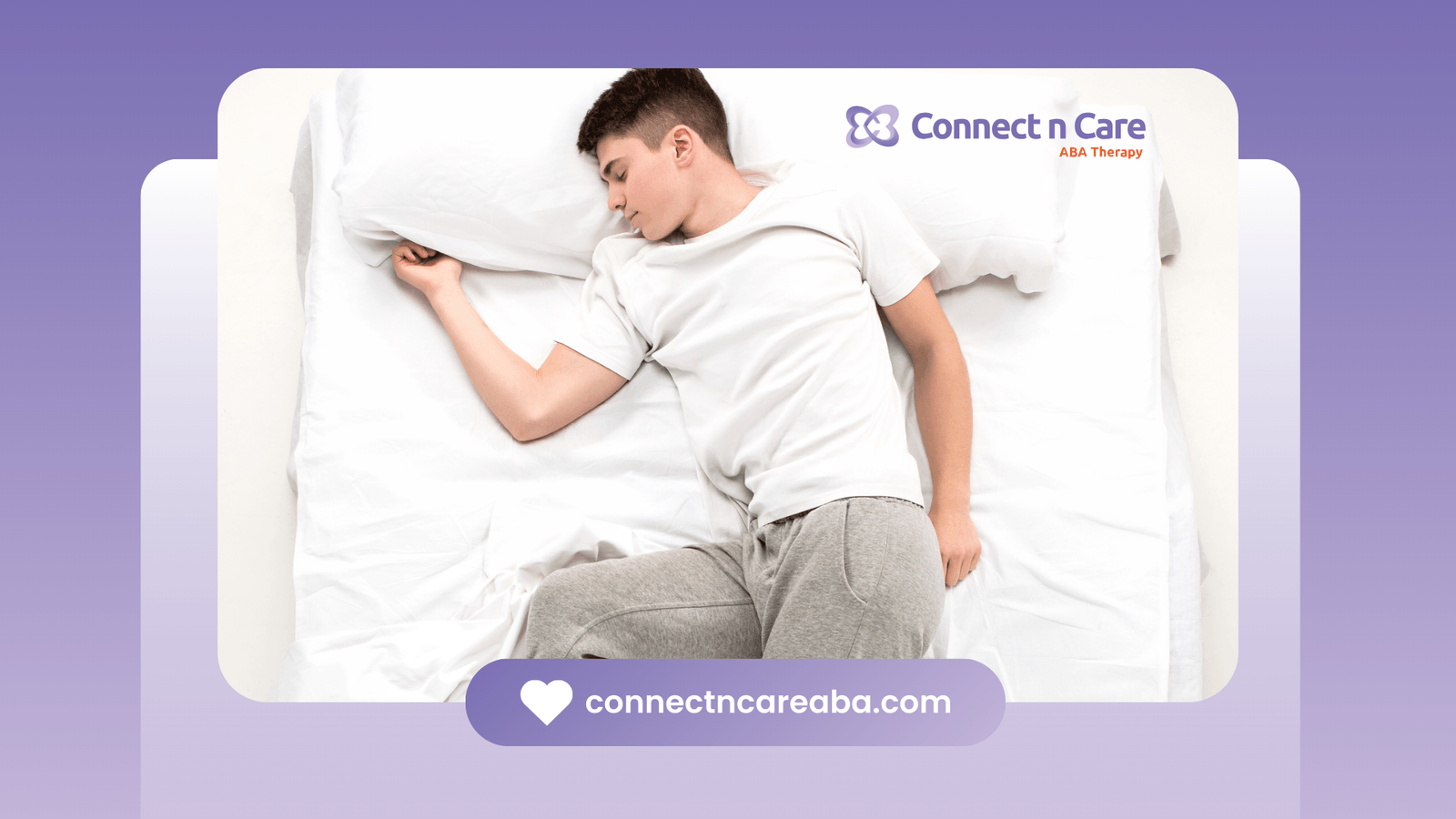
None of these positions is inherently better or worse. What matters is whether it is helping the child sleep, whether it is safe, and whether it is causing physical strain over time.
The Tight Curl
Curling into a ball wraps the limbs close to the trunk and creates a small, contained envelope around the body. Every tucked-in surface delivers proprioceptive feedback, and less skin has to be tracked by the nervous system.
For sensory-seeking children, this acts like a weighted blanket made of their own limbs. For sensory-avoidant children, the same position minimizes contact with bedding that might feel scratchy. Both groups land in the same posture for opposite reasons, which is a good reminder that you cannot read a sensory profile off a single behavior.
The Starfish
Some children sleep with arms and legs spread wide. This often looks restless but is usually the opposite: it prevents overheating, avoids unwanted pressure from bedding, and leaves the body free to move.
Starfish sleepers tend to do well with a cool room, breathable bedding, and minimal pajamas. They are the children found with the covers kicked off by morning. That is information rather than a problem. The body is saying it does not want to be wrapped.
Stomach Sleeping
Sleeping prone delivers continuous deep pressure across the front of the body, and the mattress provides a stable boundary to push against all night. For many sensory-seeking children, it is highly effective.
It also carries real trade-offs. Prone sleeping can restrict airflow around the face and strain the neck, and it is never appropriate for an infant. For older children with no breathing concerns it is generally fine, but if your child snores, breathes through their mouth, or has reflux, raise it with your pediatrician rather than settling into it.
T-Rex Arms
Wrists bent inward, elbows tucked close, fingers curled toward the chest. The community has its own name for this one, and we covered it separately in our piece on T-Rex arms in autism.
Holding the arms flexed delivers steady feedback to the wrists, elbows, and shoulders, and keeps the hands close enough that unexpected touch is unlikely. For some children, it functions as a low-grade stim. It is generally harmless, but if your child regularly wakes with numb or stiff wrists, a body pillow to hug gives similar feedback without compressing the joints for hours.
Pressed Against a Boundary
Children who need a firm edge seek out a wall, a headboard, or another person. The pressure delivers proprioceptive signals plus the sense of a fixed point in space.
This is one of the most common reasons children resist their own bed. They are not avoiding the bed. They are seeking the contact a parent's body provides, and that contact can usually be recreated with a body pillow or a snugger setup. What it must not be recreated with is a gap. A child pressed against a wall is fine. A child who can slip into the space between a mattress and a wall is not, and that gap needs closing regardless of how well the position works.
Restless Repositioning
A child who shifts constantly is not necessarily sleeping badly. Some children need movement to stay regulated, and movement can be a way of cycling through different inputs as the body's needs change across the night.
This is worth distinguishing from the rhythmic, repetitive movement of stimming, which can continue into sleep and serves a regulatory purpose. Stimming in sleep tends to look rhythmic and consistent. Sleep-disrupting restlessness looks more agitated and irregular. If your child is tired the next morning despite enough hours in bed, that is the version worth investigating.
Specific Objects and Configurations
A particular stuffed animal in a particular spot. The bed facing a particular direction. A parent's shirt under the pillow. These are sensory anchors, not quirks. The brain has built an association between the configuration and the safety of sleep.
Disrupting them, even with good intentions like washing a beloved blanket, can unravel sleep for days. Buy a duplicate of any critical lovey and rotate them so one is always broken in.
What the Evidence Says About Weighted Blankets
Weighted blankets are the most commonly recommended sensory sleep tool, and the evidence is weaker than their reputation suggests. It is worth knowing this before you spend the money.
The one randomized controlled trial in autistic children, published in Pediatrics, tested 63 children aged 5 to 16 with severe sleep problems, each using a weighted blanket and an identical unweighted blanket for two weeks in a crossover design, with sleep measured by actigraphy. The weighted blanket did not help them sleep longer, fall asleep faster, or wake less often. What the trial did find is that children and parents favored the weighted blanket, and that it was well tolerated.
That is nothing. A child who likes their blanket and finds bedtime less aversive is a real outcome, and comfort is a legitimate reason to use one. But it is a different claim from "this will improve your child's sleep," and parents deserve the accurate version before they are told a blanket is the answer.
If you do use one, the weight and suitability should come from your child's occupational therapist or pediatrician rather than an online rule of thumb. Never for infants, and not for any child who cannot move the blanket off themselves without help. If your child likes pressure but overheats, a lap pad used during the wind-down rather than a full blanket overnight delivers similar input with less heat.
Building a Sensory-Friendly Sleep Environment
Small adjustments often have outsized effects. The goal is not a perfect bedroom. It is one that reliably delivers the conditions your specific child needs.
Reduce visual input. Blackout curtains eliminate the shifts in ambient light from passing cars and early dawn that pull sensitive children out of sleep. Cover LED standby lights on chargers and electronics. For safety devices like smoke detectors, reposition rather than obscure. Check for light leaking under the door; a rolled towel usually solves it.
Control the soundscape. Silence is rarely as calming as adults assume, because the brain still has to filter sudden noises. A fan or a steady sound machine masks household noise. Children differ on which sound works, so trial and error matters, and once you find one, keep it consistent. It becomes a sleep cue the same way a routine does.
Manage temperature. Many autistic children run warm and become dysregulated when overheated, which connects to the broader pattern we cover in our piece on autism overstimulation. A cool room with breathable bedding usually works better than piling on blankets. Watch seasonal shifts, because a bedroom that works in winter often needs a fan by August.
Pay attention to texture. Seams, tags, the roughness of new sheets, the stuffing in a pillow. If your child strips off pajamas or refuses certain blankets, they are telling you their tactile preferences. Tagless pajamas, well-washed sheets, seamless socks, and unscented detergent cost almost nothing and solve a surprising share of bedtime resistance.
Keep the routine boring. The same order every night gives the nervous system clear cues. Adults sometimes try to make bedtime fun. For a child whose sensory system is already taxed, fun is the wrong direction. Visual schedules help many children by removing the uncertainty about what comes next.
Reduce evening sensory load. The hour before bed matters as much as the bedroom. Bright light and screens suppress melatonin that is already running on a different timeline, and fast-paced content keeps the system activated. A hard screen cutoff at least an hour before bed is one of the more consistently useful changes families make.
Think about the whole day. A child who needs heavy proprioceptive input and did not get any usually settles poorly. An occupational therapist can help design a sensory diet so those needs are met proactively rather than at 9 PM.
When Sleep Difficulties Point to Something Bigger
Most unusual positions are adaptive. Some patterns are worth investigating.
Persistent long sleep latency. Taking more than an hour to fall asleep on most nights despite a strong routine suggests something is interfering. Occasional rough nights are normal; a consistent pattern is not.
Night waking that does not resolve. What matters is less the number of wakings than what happens after them. A child who wakes three times and resettles within minutes is in a different category from one who wakes once and is up for an hour.
Loud snoring, gasping, or pauses in breathing. These can point to obstructive sleep apnea, which is more common in autistic children, treatable, and easy to miss. Mouth breathing, chronic congestion, and morning headaches are worth flagging too. A pediatrician referral to a sleep specialist or ENT is the usual next step.
Daytime function that tracks with sleep quality. If harder nights reliably produce harder days, sleep is doing real work in the rest of your child's life.
Sudden change after a stable period. Regressions are usually triggered by something specific: a school year, a routine change, illness, anxiety about something in the day. Identifying the trigger often points straight at the fix.
Positions causing physical strain. Numb wrists, morning neck pain, repeated bruising in the same spots. A different pillow or a position support usually resolves these without changing the child's preferred style.
Genuine sleep anxiety. Fear of the dark, of being alone, of not being able to fall asleep. This is different from sensory resistance and often needs an anxiety-focused approach alongside any sensory work.
Self-injury at bedtime or during night waking. Head-banging or hand-biting around sleep is uncommon and warrants clinical evaluation. It often signals significant dysregulation, pain, or distress the child cannot communicate directly.
How Sleep Goals Work in North Carolina and Virginia
Sleep can be addressed inside an ABA plan when it is part of a broader treatment picture, and both states we serve have specifics worth knowing.
In North Carolina, ABA falls under NC Medicaid's Clinical Coverage Policy 8F. Services run under a prior authorized treatment plan with measurable goals written by a Licensed Qualified Autism Service Provider, and that plan must be reviewed at least once every six months. That review is your scheduled moment to raise bedtime, because a goal that is not written into the plan is not being worked on. The updated policy also removed telehealth for paraprofessional services, which in practice means in-home support happens in your actual home, where bedtime actually occurs.
In Virginia, the arithmetic is tighter. Item 291.WW.2 of the 2026 Appropriation Act directs the Department of Medical Assistance Services to impose a 20-hour per week cumulative limit on ABA services, and DMAS said in a July 2026 bulletin that it will announce the effective date after federal approval. When weekly hours are capped, prioritizing matters more, and for a lot of families, sleep is the goal that unlocks the others.
Either way, the practical move is the same: name sleep specifically when you talk to your BCBA, rather than hoping it gets absorbed into general regulation goals.
Practical Steps for Parents
Keep a two-week sleep log first. Bedtime, actual sleep onset, night wakings, morning wake time, and how the next day went. Do not fix anything yet. Also track dinner timing, screen time, room temperature, and what they wore. Small details often turn out to be the variable.
Change one thing at a time. Give each change a week before adjusting anything else. Overhaul the whole bedroom at once, and you will have no idea what worked.
Respect the arrangement, within safety limits. If your child sleeps best curled at the foot of the bed on top of the covers, that is information. The instinct to fix it usually comes from somewhere good, but the body has done a lot of work to land on what works. Override it only where safety requires it.
Build a wind-down runway. High-energy play ends about 90 minutes before bed, screens off 60 minutes before, dim lights and quiet activity for 30 minutes, then routine. A gentle descent rather than a hard landing.
Hold the routine through regressions. When sleep wobbles, the temptation is to abandon what had been working. Removing the routine during a hard stretch tends to make recovery longer.
Protect the adults. Parents running on months of broken sleep have a harder time being patient, consistent, and creative at exactly the moment those things matter most. If one parent can take nights for a stretch while the other catches up, do it.
Conclusion
Autistic sleeping positions usually make sensory sense. The tight curl and the wall-press deliver proprioceptive feedback that tells the nervous system where the body ends. The starfish keeps a warm child cool and unwrapped. T-Rex arms give steady joint input at low cost. Stomach sleeping delivers deep pressure with real trade-offs around airflow. Restless repositioning is often regulation rather than poor sleep. Sleep problems affect the large majority of autistic children, and melatonin timing, sensory profile, transition anxiety, and conditions like obstructive sleep apnea all contribute. Weighted blankets are better supported as comfort than as a sleep intervention, and the AAP's safe sleep rules override every preference described here for any child under one. The parent's job is not to correct how their child sleeps. It is to work out what the body is asking for, deliver it safely and consistently, and escalate the handful of patterns that genuinely warrant a clinician.
Ready to Talk About Bedtime?
Connect n Care ABA provides ABA parent training, in-home ABA therapy, and early intervention ABA to families across North Carolina and Virginia, and in-home is where a BCBA can watch your actual bedtime in your actual house.
If sleep has been hard for a while and you are not sure where to start, contact our team, and we will help you work out what to look at first.
SOURCES:
- https://publications.aap.org/pediatrics/article/150/1/e2022057990/188304/Sleep-Related-Infant-Deaths-Updated-2022
- https://publications.aap.org/aapnews/news/28768/AAP-leaders-call-decision-to-pull-harmful-weighted
- https://pubmed.ncbi.nlm.nih.gov/25022743/
- https://psychiatryonline.org/doi/full/10.1176/appi.focus.20230028
- https://pmc.ncbi.nlm.nih.gov/articles/PMC12651674/
- https://medicaid.ncdhhs.gov/8f-research-based-behavioral-health-treatment-rb-bht-autism-spectrum-disorder-asd
- https://vamedicaid.dmas.virginia.gov/bulletin/applied-behavior-analysis-aba-policy-changes